
January 12, 2026
⯀
33
min


Gamification can boost app retention by 47% and keep 90% of users engaged with its features. Why? It taps into human psychology - our love for rewards, progress, and recognition. Here’s a quick breakdown of 10 proven techniques to keep users coming back:
These techniques can be layered for maximum impact, like pairing streaks with leaderboards or badges with progress bars. Start simple, track user engagement, and expand based on what works best for your audience.
Points and experience (XP) systems offer users a way to see and measure their progress. Whether it’s completing a lesson, finishing a workout, or hitting a daily goal, these actions translate into rewards that users can track. This creates a feedback loop where progress feels tangible, sparking a natural drive to achieve even more.
Humans are wired to seek achievement and mastery. Watching XP pile up and levels increase satisfies both the internal desire to get better at something and the external validation of reaching milestones. This constant sense of progression keeps users engaged by always offering a new level or goal to strive for, reducing the risk of losing interest.
The numbers back it up. Gamified loyalty programs that use points systems have seen a 22% boost in customer retention, which directly impacts customer lifetime value. Take Duolingo, for example. By combining XP with fun animations and sound effects, they’ve achieved a 55% day-after retention rate. Fitness apps like Nike Run Club have also benefited, reporting a 21% increase in user engagement through similar reward systems.
Setting up an XP system doesn’t have to be overly complex. Focus on rewarding key actions that align with your app’s purpose - like workouts for fitness apps or completed lessons for educational platforms. Khan Academy, for instance, uses XP to motivate users to level up, giving them a sense of accomplishment. Just make sure users clearly understand how to earn points and hit milestones.
Visual feedback plays a huge role here. Progress bars, level indicators, and numerical displays let users see exactly how close they are to their next goal. Celebrating moments like leveling up or reaching a new XP threshold reinforces positive behavior and gives users a reason to keep coming back.
This approach works across different types of apps, from education to fitness. The key is balance: if points are too easy to earn, they lose their impact; if they’re too hard, users might give up. Start with small, achievable goals to build momentum, then gradually introduce more challenging milestones.
To take it a step further, consider adding badges or leaderboards. Fitbit, for example, pairs XP-style progression with badges and milestones to celebrate fitness achievements. This creates multiple layers of motivation, keeping users engaged through various reward loops.
Begin with a simple system and use analytics to fine-tune it. Assign point values thoughtfully and observe how users respond before adding more complexity. The goal is to make points feel like a natural part of your app’s experience - not just an extra feature bolted on.
Badges transform key milestones into visual rewards that users can collect and display with pride. Unlike points, which accumulate over time, badges celebrate specific accomplishments - like completing your first workout, hitting 10,000 steps, or virtually scaling a famous landmark. They provide a concrete sense of progress and achievement.
Badges tap into users' desire for recognition and help build a connection with the app. When someone earns a badge, it’s more than just a reward - it’s a moment of acknowledgment that motivates them to keep going.
What makes badges stand out is their ability to highlight qualitative achievements. Instead of simply measuring quantity, they celebrate meaningful moments, whether it’s maintaining a streak, achieving a personal best, or trying out a new feature. Each badge tells a story, making the experience more personal and encouraging users to come back for more.
Studies show that gamification elements like badges can increase customer retention and social sharing by 22% - a win for both user engagement and app growth.
For badges to truly resonate, they need to represent milestones that users care about. Fitness apps like Fitbit award badges for hitting goals like 10,000 steps, while Snapchat uses trophies and emojis to reward users for engaging with its features. On educational platforms like Khan Academy, badges celebrate learning progress, making achievements feel more tangible. Even meditation apps like Headspace use animations and streak-based badges to make mindfulness feel rewarding.
The key is to design badges that align with meaningful achievements. Whether it’s a fitness goal, a learning milestone, or a streak of consistent usage, badges should feel earned and valuable.
To implement a badge system effectively, you’ll need to:
For expert guidance on integrating gamification features, you can explore resources like Dots Mobile (https://dots-mobile.com). If you’re working with limited resources, focus on a handful of key badges that tie directly to user retention goals.
Celebrating badge achievements is just as important as the badges themselves. Notifications, animations, or profile highlights can make earning a badge feel like a big moment, reinforcing positive behavior.
Badges work best when paired with other gamification elements. For example, a user might earn a "Consistency Champion" badge for maintaining a streak, and leaderboards can showcase those with the most prestigious badges. This layered approach combines daily motivation, milestone recognition, and a touch of competition to keep users engaged.
Tiered badges, like bronze, silver, and gold levels, can also encourage long-term engagement by showing a clear progression path. To make the experience even more personal, consider tailoring badges to individual preferences - for instance, offering different badges based on exercise types in a fitness app.
Tracking metrics like badge completion rates, the time it takes users to earn their first badge, and the connection between badge achievements and retention can provide valuable insights. Monitoring how often users share their badges on social media can also reveal how emotionally invested they are in the app. By analyzing these metrics alongside other gamification features, you can refine your strategy and demonstrate the impact on user engagement.
From fitness apps encouraging healthy habits to educational platforms celebrating learning milestones, badges are a versatile and powerful tool. When thoughtfully designed, they give users a reason to return, achieve more, and proudly grow their collection.
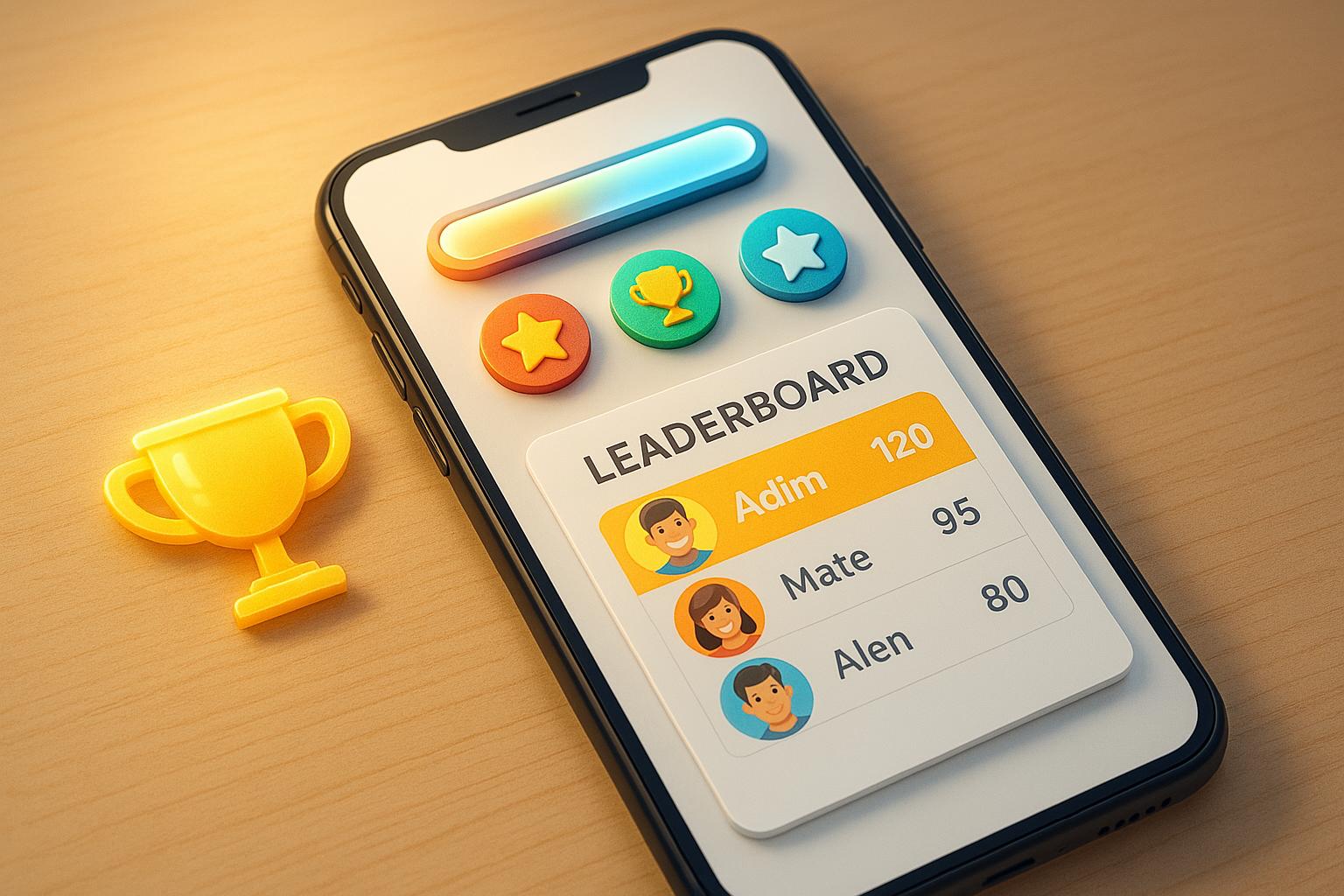
Leaderboards transform app interactions into fun, competitive experiences. By tapping into our natural desire to compete and succeed, they encourage users to engage more frequently and stick around longer.
Leaderboards work because they leverage our innate drive to outperform others. Users compare their progress with peers, which sparks motivation to climb the rankings. This creates a cycle where users repeatedly check their standings, aim to improve, and engage more deeply with the app.
The results don’t lie. Fitbit users who engaged with its leaderboard system increased their daily steps by 15% - a clear example of how competition can drive behavior. Apps that implement leaderboards often see higher user retention because they provide ongoing motivation, not just one-off rewards.
Nike Run Club is a standout example. The app uses weekly leagues to spark friendly competition while integrating other gamified elements like XP systems and badges. This combination gives users multiple reasons to stay active - whether it’s chasing the top leaderboard spot or hitting personal milestones.
Leaderboards are especially effective in fitness apps, where users naturally compete on metrics like steps, workouts, or running distances. Language-learning apps also use them to make daily practice more engaging, turning vocabulary drills into friendly races. Similarly, educational platforms use rankings to encourage studying by making it feel like a game.
Social and gaming apps are another natural fit. Snapchat, for instance, doesn’t use traditional leaderboards but creates a competitive environment with streaks, trophies, and emoji rewards - features that keep users coming back daily. The key is ensuring the competition aligns with your app’s purpose, so it feels organic rather than forced.
Leaderboards require careful planning to work seamlessly. Start by deciding their scope: will rankings be global, regional, friend-based, or segmented by skill? Friend-based leaderboards often perform better because competing with people you know feels more meaningful than chasing anonymous global rankings.
Also, think about how often rankings update. Real-time updates can create excitement but demand more server resources, while weekly or monthly updates reduce pressure and keep the competition approachable. Weekly resets, for example, give everyone a fresh start and prevent top-tier users from dominating indefinitely, which can discourage newcomers.
For technical challenges, partnering with experienced developers like Dots Mobile (https://dots-mobile.com) can ensure your leaderboard system is scalable, reliable, and tailored to your audience.
To keep leaderboards fun for everyone, group users by skill level or experience. This way, beginners aren’t discouraged by competing against advanced users. Highlighting multiple metrics - like “most improved,” “most consistent,” or “personal best” - can also make progress feel meaningful for users at every level.
Seasonal or weekly resets are another great way to maintain engagement. They level the playing field, giving new or returning users a fair shot at climbing the rankings, while keeping the competition fresh and exciting.
Leaderboards work even better when paired with other gamification tools like badges and streaks. Together, these elements tap into different motivations: leaderboards drive competition, badges offer recognition, and streaks encourage consistent habits.
You can also tie in-app rewards to leaderboard performance. For instance, top-ranked users might unlock exclusive features or earn bonuses, while everyone can feel rewarded for personal achievements. Progress bars and visual trackers can further enhance the experience by showing users how close they are to reaching their goals, making their journey more engaging.
To see if your leaderboard is effective, track metrics like session length, return frequency, and the number of active competitors. Compare retention rates between users who interact with the leaderboard and those who don’t.
Also, monitor how many users view and engage with the leaderboard. If visibility is high but engagement is low, it might mean the feature isn’t compelling or easy to use.
Be cautious of making leaderboards too challenging for new users. If beginners feel they can’t compete, they’re likely to disengage. Similarly, ensure your system can’t be exploited - leaderboards lose their appeal if users can game the system unfairly.
Frequent updates keep leaderboards exciting, but avoid relying on a single metric for rankings. A narrow focus might not reflect the full range of user achievements. Offering customization options or an opt-out feature can also help, as not everyone enjoys competition. Some users may prefer focusing on personal goals, and flexibility ensures they stay engaged without feeling pressured.
When thoughtfully designed, leaderboards turn ordinary app interactions into engaging challenges that keep users coming back for more.
Daily streaks are a clever way to reward users for consistent behavior, tapping into the psychological concept of loss aversion to keep them engaged. Once users build a streak, they often feel emotionally tied to maintaining it, which can turn sporadic actions into daily habits.
Adding gamified loyalty features like streaks can lead to a 22% increase in customer retention, which directly boosts customer lifetime value. A great example is Snapchat's streak system, where users send daily snaps to keep their streak alive. The app enhances this experience with fun rewards like trophies or emojis, transforming mundane interactions into engaging routines. This strategy has proven effective in turning casual users into dedicated daily participants.
Daily streaks work particularly well in apps that thrive on repeated user engagement. Here are a few standout examples:
To design an effective streak feature, consider these essentials:
For apps requiring advanced streak tracking and notification systems, working with experienced developers like Dots Mobile ensures a seamless and scalable implementation. Pair these fundamentals with other gamification tools to maximize retention.
While streaks are excellent for engagement, they can backfire if users feel too much pressure. Breaking a streak might trigger guilt, and some users could abandon the app altogether. To avoid this, consider adding recovery options, like allowing users to restore a streak through a small in-app purchase or bonus challenge. Make it clear that streaks are about encouraging consistency, not creating stress. The goal is to make daily actions feel rewarding, not overwhelming.
Customizing streak challenges based on user behavior can make the system even more effective. For newer users, shorter streak goals (like 3 or 7 days) can help build confidence and establish a habit. For more engaged users, longer streaks or streak multipliers - where consecutive weeks unlock bigger rewards - can add an extra layer of excitement.
To understand how well your streak system is working, track these key metrics:
Streaks are even more effective when paired with other gamification elements. Consider integrating them with:
Progress bars act like signposts on a journey, showing users how far they’ve come and what’s left to accomplish. By offering real-time updates, they transform tasks into engaging milestones. When paired with elements like points, streaks, and badges, progress bars create a well-rounded gamified experience.
Progress bars turn abstract goals into something users can see and measure. Unlike points that reward specific actions or badges that celebrate milestones, progress bars provide continuous feedback. This constant visual cue taps into our innate desire to see things through. For instance, watching a progress bar jump from 60% to 80% during onboarding can create a sense of momentum, motivating users to finish the task.
Fitbit users, for example, increase their daily step counts by 15% thanks to engaging progress tracking features. By combining progress bars with milestone badges (like hitting 10,000 steps) and themed challenges like "Hiking the Alps", Fitbit turns fitness into an adventure. Similarly, Nike Run Club uses progress stats, virtual trophies, and personalized messages to keep users coming back. This steady stream of feedback encourages long-term commitment.
Progress bars shine in apps with clear, goal-oriented journeys. Educational platforms like Khan Academy use them to show learning progress through courses and skill trees. Fitness and productivity apps also benefit. Take the Forest app, for instance - it lets users grow a virtual tree while staying focused, eventually building an entire forest that reflects their productivity. For onboarding flows, progress bars break a complex setup into manageable steps, boosting user confidence and reducing drop-off rates.
Adding a basic progress bar is relatively simple: track user actions, calculate completion percentages, and display visual feedback using standard mobile frameworks. However, things get trickier when tracking multiple goals or syncing progress across devices. Start with basic visualizations and test them thoroughly. As your app grows, consider working with experienced developers - like those at Dots Mobile - to ensure your progress tracking remains scalable and integrates seamlessly with other gamification features.
Good design is key to making progress bars effective. Use colors strategically - green, for example, signals progress. Add smooth animations to celebrate milestones and include clear labels that show both current status and end goals. Animation speed also matters: too fast, and it feels unearned; too slow, and users might lose patience. Headspace, for example, uses visual journeys and milestone animations to make meditation feel more rewarding and tangible.
Progress bars can evolve with the user journey. During onboarding, fast-moving bars build confidence and encourage completion. Later, they can track milestones that unlock new features. Duolingo is a great example - it combines points, levels, badges, and streaks to help learners track their progress over time. For long-term retention, progress bars can highlight loyalty rewards or aspirational goals, keeping users engaged well beyond the initial experience.
Progress bars work best when combined with other gamification features like streaks, leaderboards, and rewards. For example, a daily streak could directly contribute to a user’s overall progress, while rewards at key milestones provide moments of celebration. This layered approach creates multiple feedback loops, making it far more effective at driving engagement than relying on a single element.
To keep progress bars effective, ensure they update in real-time to avoid frustrating users. Avoid making progress overly granular, as it can feel insignificant, or setting goals that seem impossible, which can discourage users. Other mistakes include hiding progress bars in hard-to-find areas or resetting progress unexpectedly, which can break user trust. Testing with real users during development is crucial to catch and fix these issues, ensuring your progress bars remain a powerful tool for engagement and retention.
Challenges and quests transform routine tasks into engaging adventures. With clear goals, captivating narratives, and enticing rewards, they turn ordinary interactions into experiences that keep users coming back for more.
Challenges tap into our innate desire for achievement, independence, and mastery. They trigger dopamine, reinforcing positive behavior and creating a sense of accomplishment. Adding a narrative element amplifies this effect. For instance, Zombies, Run! turns running into an immersive experience, complete with audio cues and storylines that motivate users to keep moving. This storytelling approach sets challenges apart from other gamification techniques.
Challenges differ from badges and leaderboards by offering structured, goal-driven experiences within a narrative framework. While badges recognize achievements and leaderboards encourage competition, challenges focus on completing specific tasks within a set timeframe. Quests, on the other hand, provide evolving storylines with sequential missions, making them more dynamic.
Challenges have proven effective across various app categories, each tailoring them to fit their core purpose. For example:
These tailored approaches not only enhance user experience but also drive retention.
Gamified loyalty programs with challenges and milestones can increase customer retention by 22%. Fitbit's leaderboard challenges, for instance, have been shown to boost daily steps by 15%. Additionally, gamification can lead to a 22% rise in social media sharing. By creating daily engagement loops, challenges ensure users keep returning to the app.
Designing challenges requires careful planning and technical precision. Simple challenges, like "complete 5 workouts this week", rely on basic backend systems to track progress. However, more complex quests with narratives, sequential stages, and conditional rewards demand advanced systems to manage quest states, synchronize data, and trigger notifications. For apps with limited resources, starting with straightforward challenges is a practical first step. For more intricate implementations, collaborating with experienced developers, such as those at Dots Mobile, can ensure scalability and smooth integration.
To avoid user fatigue, challenges must strike the right balance between difficulty and achievability. Start with quick wins during onboarding to build confidence, introduce mid-level challenges as users become more engaged, and offer tiered challenges for long-term users. Clear instructions, deadlines, and rewards are essential. Visual cues like progress bars and countdown timers help users stay focused. It's also important to avoid making challenges feel like a chore - offering various difficulty levels lets users choose what suits them best.
Rewards are key to keeping users motivated. These can include:
Instant rewards, like coupon codes, provide immediate gratification, while tiered reward systems encourage users to stay engaged over time.
Personalized challenges resonate more with users. By tailoring tasks to individual skill levels, past behavior, and preferences, apps can offer simpler challenges for beginners and more intricate quests for seasoned users. Adding a personal touch, such as themed adventures or customizable avatars, helps users feel more connected to their progress. Personalized recommendations for upcoming challenges can further increase participation rates.
Success can be measured by monitoring metrics like completion rates, time-to-completion, repeat engagement, and overall retention. Analyzing which challenges drive the most interaction allows developers to refine their approach. Cohort analysis can reveal how engaged users compare to a control group, while tracking social sharing metrics can highlight the viral potential of gamified features.
Rewards and in-app incentives transform everyday app interactions into moments of delight. By offering points, badges, unlockable content, or even real-world perks like discount codes, apps create a feedback loop that keeps users coming back. The key? Making these rewards feel earned and worthwhile.
At their core, rewards tap into our innate desire for achievement, progress, and recognition. They combine the personal satisfaction of growth with external motivators like points or badges. Every small win triggers a dopamine release, reinforcing habits and building a sense of accomplishment. Interestingly, unpredictable rewards - delivered on a variable schedule - are even more effective. This element of surprise generates anticipation, making the experience more engaging.
Apps can use a variety of reward strategies to keep users engaged:
Take Duolingo, for example. Its multi-layered reward system includes XP points, badges, streaks, and a heart system, creating a habit-forming loop that keeps users motivated.
Incorporating gamified rewards has proven to boost retention rates significantly. Businesses using loyalty programs see a 22% increase in customer retention. Apps that gamify their experience often report a 30% jump in session duration and a 22% rise in social media sharing.
Different app categories can tailor rewards to fit their goals:
A well-designed reward system balances quick wins with long-term engagement. Start by offering easy achievements during onboarding - like progress meters - to build momentum. Over time, introduce more challenging goals and unlockable content to deepen involvement. Mixing predictable rewards with occasional surprises keeps the experience fresh and engaging.
The complexity of your rewards system depends on your app's goals:
If resources are tight, start small with simple gamified experiments. Quick, instant rewards can have a big impact. For more advanced setups, consider working with experienced developers like Dots Mobile to ensure a smooth implementation.
Social features can amplify the impact of rewards. Allowing users to share achievements builds community and creates social proof. Leaderboards and friendly challenges add a competitive edge that keeps users engaged. Fitbit, for instance, lets users challenge friends, boosting both engagement and app visibility. Social sharing of achievements can even increase app visibility by 22%.
To assess the effectiveness of your rewards system, track these key metrics:
Using analytics tools to track these metrics can help you refine and scale your reward strategy. When combined with elements like points, badges, and leaderboards, a well-structured reward system can significantly boost user retention and engagement.
Levels and progression systems turn app usage into a journey of milestones. By earning experience points (XP) and advancing through levels, users gain a clear sense of accomplishment and growth. This visible progress creates a psychological pull that encourages users to keep coming back.
Humans naturally crave achievement and mastery. Levels tap into this by offering clear milestones that signal progress. Moving from one level to the next (e.g., Level 1 to Level 50) reflects growing skills and validates effort. As users approach the next level, the "goal gradient effect" often kicks in, motivating them to push just a bit further - like thinking, "Only 200 XP to Level 15? I’ll finish one more task!" Visual elements such as progress bars, unlocked badges, and increasing XP counters amplify this sense of advancement. Together, these cues create a rewarding cycle that keeps users engaged.
XP systems and levels are a perfect match for keeping users motivated. XP rewards small, frequent actions - like completing tasks or challenges - while leveling up offers the satisfaction of achieving bigger milestones. A well-thought-out progression curve is key here: early levels should be quick to achieve, requiring, say, 100 XP, to build early momentum. Later levels, however, might demand 500 XP or even 2,000+ XP to maintain a sense of challenge and accomplishment.
Building a basic progression system isn’t overly complicated. It typically involves tracking user activity, assigning XP, and triggering notifications when users level up. Many app development platforms even offer tools or SDKs to simplify this process. Starting with a straightforward system allows you to test the concept before introducing more advanced features.
Levels and progression systems shine in a wide range of apps. Educational platforms like Khan Academy use levels to gamify learning, motivating users to tackle tougher content. Fitness apps also excel in this area - Nike Run Club, for example, rewards users with XP for workouts, while Fitbit’s level-based achievements have led to a 15% increase in daily steps. Health and wellness apps, such as Headspace, make abstract goals like mindfulness feel concrete by displaying progress visually. Even fintech apps like Moven have adopted these systems, encouraging users to save more effectively - users are 50% more likely to save when progression mechanics are in place. The key is ensuring that levels align with meaningful actions tied to the app’s core purpose.
Levels and progression systems can significantly improve user retention. As users invest time and effort into reaching higher levels, they become more attached to the app, making them less likely to switch to a competitor. However, finding the right pacing is crucial: if levels are too easy to achieve, the sense of accomplishment fades; if they’re too difficult, users may grow frustrated and disengage.
Levels also act as a form of social proof, showcasing users’ status and encouraging friendly competition. Leaderboards or comparisons with friends’ levels can motivate users to stay active and maintain their rank. That said, it’s important to design these systems thoughtfully - large level gaps can discourage newcomers who feel they’ll never catch up.
Levels are most effective when combined with other gamification elements. For instance, tying badges to level milestones - like earning a "Level 10 Master" badge - creates multiple layers of rewards for a single achievement. Challenges can be restricted to certain levels to ensure appropriate difficulty, and in-app rewards can scale with levels, unlocking premium features or exclusive content. Daily streaks paired with level progression add another layer of engagement, while level-based leaderboards keep competition fun and accessible. When integrated with other gamified features, levels create a cohesive and engaging user experience.
Social features transform solitary app interactions into shared experiences. Whether it's competing with friends, celebrating achievements, or joining community challenges, these elements tap into our natural desire for connection and recognition. They also amplify the gamification strategies discussed earlier, fostering engagement through shared accountability and interaction.
People crave recognition and thrive on friendly competition. Apps that include features like leaderboards, community challenges, or shared achievements create a sense of belonging that extends beyond the app's core functionality. This combination of personal accomplishment and peer validation builds a sense of social responsibility, making users more likely to stay engaged - especially when their friends or community are involved.
Leaderboards are a classic way to encourage competition and drive engagement. To ensure they remain inviting and fair, apps can introduce features like periodic resets (weekly or monthly) or skill-based groupings, so new users don't feel overwhelmed.

Snapchat's streak system is a great example of how timely rewards and social accountability can build habits. By encouraging users to maintain streaks with friends, Snapchat seamlessly integrates social gamification into daily routines.
Certain app categories thrive on social engagement. Fitness apps like Nike Run Club and Fitbit let users share milestones, compare stats, and join group challenges, fostering a sense of community and healthy competition. Similarly, language-learning platforms like Duolingo use streak competitions and group milestones to make learning a shared, interactive experience. These features add a social dimension that strengthens both individual and collective motivation.
Leaderboards are just one piece of the puzzle. Other social mechanics can deepen user interaction:
Interestingly, gamified loyalty programs with social features have been shown to boost customer retention by 22% and increase social media sharing by the same percentage.
Adding social features can range from straightforward to complex. For example, leaderboards require backend systems to track metrics and update standings in real time, while friend-based features involve user management and notifications. Privacy and security are crucial - users should have clear options to opt in or out. If resources are tight, start small and expand as your app grows. Partnering with experienced developers, like Dots Mobile (https://dots-mobile.com), can help ensure smooth, secure integration of these features.
Social features don't just boost retention - they also drive user acquisition. When users invite friends to join challenges or competitions, they naturally promote the app. This word-of-mouth effect creates a self-sustaining cycle: more users mean a larger community, which enhances engagement and fuels long-term growth.
Building on gamification tools, personalization takes engagement to a whole new level. When users can design a digital version of themselves, it sparks a sense of ownership and connection. Avatar customization turns routine app interactions into deeply personal experiences, making users feel like the app is a reflection of their identity instead of just another tool on their phone.
Avatar customization taps into our need for self-expression and autonomy, creating an emotional tie to the app. Picking colors, hairstyles, or unlocking unique accessories allows users to express their individuality, turning the app into something they truly care about.
Take Habitica, for example. It links productivity with avatar development, rewarding users for completing tasks and sticking to good habits. The avatar becomes a symbol of their progress, transforming mundane to-do lists into an exciting adventure.
While avatar customization can enhance many types of apps, some categories benefit more than others:
Adding avatar customization doesn’t have to be overly complex. Start with basic options like preset templates or name personalization, which require minimal backend development. As your app grows, you can introduce more advanced features like detailed clothing choices, animations, or dynamic updates.
For those building gamification features from scratch, collaborating with experienced developers can make the process smoother. Companies like Dots Mobile specialize in creating scalable apps with robust personalization features, using technologies like Swift and Kotlin.
Avatar customization works even better when combined with rewards, points, and progression systems. While points and XP systems offer immediate gratification, avatars create a deeper, long-term connection. Badges and achievements spotlight specific milestones, but avatars reflect the user’s overall journey within the app.
Incorporating personalized elements into gamified loyalty programs can boost customer retention by 22%. The key is synergy - linking avatar customization with challenges, quests, and progress tracking provides a multi-layered retention strategy that appeals to various psychological drivers.
The best avatar systems strike a balance between variety and simplicity. Key customization options include:
For advanced systems, consider animated expressions, special effects, or upgrades users can earn through gameplay or purchases. The most effective setups tie avatar evolution directly to user accomplishments, like unlocking new outfits after completing 50 workouts or earning exclusive accessories for maintaining a 30-day streak.
Avatar customization becomes even more powerful when paired with social features. Integrating avatars into leaderboards or friend lists encourages users to return, not just to maintain their own avatars but to see how they compare to others. Social interactions like collaborative challenges or community events can further enhance engagement.
To measure the impact of avatar customization, focus on these metrics:
Additionally, compare churn rate and lifetime value between users who personalize their avatars and those who don’t. These insights help refine your avatar features, ensuring they deliver real results and keep users engaged. By integrating customizable avatars with other gamified elements, you can create a rich, cohesive experience that encourages long-term retention.
Choosing the right gamification techniques for your app starts with understanding how each one functions, the effort required to implement it, and which types of apps benefit the most. Below is a table comparing 10 gamification techniques across four key dimensions, offering a clear guide for shaping your retention strategies. This summary builds on previously discussed techniques to provide a practical roadmap for integrating gamification into your app.
| Gamification Technique | Psychological Driver | Development Effort | Retention Impact | Best-Suited App Categories |
|---|---|---|---|---|
| Points and XP Systems | Achievement, Progress | Low | Medium | Education, Fitness, Productivity |
| Badges and Achievements | Accomplishment, Recognition | Low-Medium | Medium | All categories |
| Leaderboards and Competitive Ranking | Social comparison, Competition | Medium | High | Fitness, Sports, Gaming, Social |
| Daily Streaks and Consistency Rewards | Loss aversion, Habit formation | Low | High | Fitness, Meditation, Productivity, Language Learning |
| Progress Bars and Visual Tracking | Progress visualization, Motivation | Low | Medium | Onboarding, Education, Fitness |
| Challenges and Quests | Purpose, Accomplishment | Medium | Medium-High | Gaming, Fitness, Education |
| Rewards and In-App Incentives | External motivation, Reinforcement | Low-Medium | Medium | E-commerce, Loyalty, All categories |
| Levels and Progression Systems | Mastery, Achievement | Medium | High | Gaming, Education, Fitness |
| Social Features and Community Engagement | Belonging, Social motivation | High | High | Social, Fitness, Gaming, Community |
| Personalization and Avatar Customization | Autonomy, Self-expression | Medium | Medium | Gaming, Social, Fitness |
Some gamification techniques stand out for delivering strong results with minimal effort. For example, daily streaks and leaderboards are relatively simple to implement but can significantly boost engagement by tapping into loss aversion and social competition. These features encourage users to stay consistent and return to the app regularly.
On the other hand, techniques like points systems, badges, and progress bars are easy to set up and require basic backend tracking. They’re ideal for early-stage apps with limited resources, helping you gather insights into user preferences before diving into more intricate systems.
Mid-level features such as challenges, quests, and levels demand more effort, as they involve tracking milestones and creating progression logic. However, they’re worth the investment because they sustain user interest over time by creating meaningful feedback loops.
High-complexity features like social engagement tools and community functions require advanced infrastructure for messaging, user connections, and real-time updates. These systems are best suited for apps where social interaction is a core value, making the development effort worthwhile.
Different app categories benefit from specific gamification techniques. For instance:
Every gamification technique taps into specific psychological needs. Features like points, badges, and levels appeal to the desire for achievement and mastery. Leaderboards and competitive rankings activate social comparison, while daily streaks leverage loss aversion to keep users engaged - breaking a streak feels like losing progress, which users actively avoid. In fact, apps with gamified loyalty programs have seen a 22% increase in customer retention.
Customization options, such as avatars, cater to users’ need for autonomy and self-expression. These features create a sense of ownership and deepen emotional connections, making the app feel more personal.
Your app’s development stage should guide how you prioritize gamification features. During onboarding, start with quick and simple wins like progress bars and visual tracking. These help users build momentum without overwhelming them.
For early-stage apps, focus on low-complexity, high-impact techniques like points, badges, and streaks. These require minimal resources but provide valuable data on user behavior.
As your app matures, introduce mid-level features such as challenges, habit-tracking tools, and feature unlocks to deepen engagement. For long-term users, consider adding tiered loyalty systems, status milestones, or social features to maximize lifetime value.
The most effective gamification strategies combine multiple techniques that work together rather than compete for attention. For example:
Gamification taps into our natural drive for achievement, progress, and recognition, resulting in a 22% increase in customer retention and boosting lifetime value.
To make gamification work for your app, start small and let user data guide you. There's no need to roll out every feature at once. Begin with one or two core elements that align with your app's purpose and user preferences. Use analytics to monitor how users interact with these features, then refine and expand based on what resonates most.
Your approach should adapt as your app and its users grow. During onboarding, focus on quick wins like progress trackers to get users invested early. As engagement deepens, introduce mid-level challenges or habit-forming tools. For long-term users, features like social interactions or tiered loyalty programs can keep them coming back. This gradual evolution mirrors the user journey - from onboarding to mastery - ensuring that your app feels intuitive, engaging, and never overwhelming.
The best gamification strategies combine techniques that complement each other. For example, pair progress bars with challenges so users can visualize their progress. Link badges to streak milestones to encourage consistency. Use leaderboards alongside point systems to give users a sense of context and competition. When these elements work together, they create a seamless and rewarding experience.
If you're ready to bring gamification to your mobile app, Dots Mobile has the expertise to make it happen. Their services cover everything from UI/UX design to iOS (Swift) and Android (Kotlin, Java) development, backend systems (Python, Django, Node.js) for real-time features, quality assurance, and App Store optimization.
"They set clear expectations, delivered everything ahead of schedule and within budget, and approached complex tasks with a scalable, well-thought-out strategy."
- Brock Jones, CEO at Bambii
Gamification transforms interactions into something more engaging and rewarding, creating experiences users will want to return to again and again.
To choose the best gamification techniques for your app, begin by diving into what makes your audience tick. What drives them? Are they motivated by rewards, a little friendly competition, or hitting personal milestones? You can uncover these insights through user research methods like surveys or focus groups.
Once you have a clear picture of your audience, make sure your gamification strategies match the purpose of your app. For instance, if you’re working on a fitness app, features like progress tracking, achievement badges, or leaderboards can inspire users to stay active and engaged. Don’t forget to experiment with different techniques and gather feedback - this will help you fine-tune your approach and keep users coming back for more.
When adding gamification to your app, there are a few common mistakes you'll want to steer clear of to ensure a smooth user experience and strong retention. Making the design overly complex is a big one. Gamified features should be easy to understand and use - if they confuse your users, they’ll likely disengage.
Another misstep is ignoring what your audience actually wants. Gamification should reflect the interests and habits of your target users. If it doesn’t resonate with them, it won’t be effective.
Overloading users with rewards is also a trap to avoid. If you’re constantly handing out incentives, they can lose their meaning. Instead, focus on delivering rewards that feel purposeful and encourage users to stick around for the long haul.
Finally, don’t let gamification feel out of place. Every feature you add should tie back to the app’s main purpose and provide real value to the user. Forced or irrelevant gamification can do more harm than good.
To gauge how well your gamification efforts are working, keep an eye on key performance indicators (KPIs) such as retention rate, daily active users (DAU), and session duration. These metrics give you a clear picture of whether your strategies are keeping users engaged and encouraging them to return over time.
It's also worth listening directly to your users. Collecting feedback through in-app surveys can reveal how they feel about the gamified elements. For a more analytical approach, try using A/B testing. By comparing user behavior with and without specific gamification features, you can identify what works best and fine-tune your approach for better results.


