
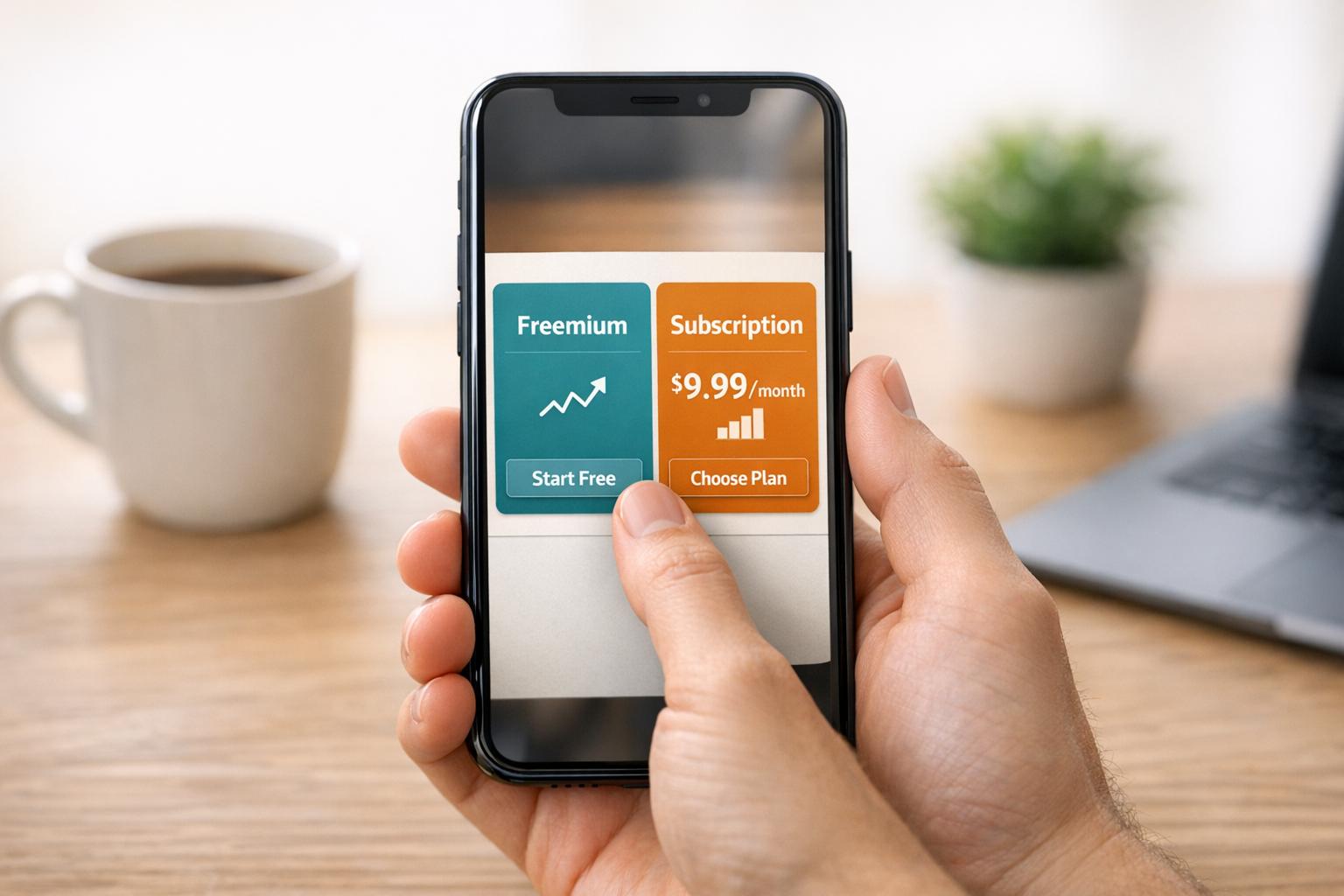
January 29, 2026
⯀
13
min


Deciding how to make money from your app comes down to two main choices: freemium or subscription. Freemium apps are free to download but offer paid upgrades or features, while subscription apps charge users recurring fees for premium access.
Here’s the key takeaway:
Quick Comparison:
| Factor | Freemium | Subscription |
|---|---|---|
| Revenue Predictability | Low; depends on upgrades or ads | High; recurring billing ensures stability |
| User Base | Large, diverse, less committed | Smaller, more engaged |
| Conversion Rate | 2–5% | 18–40% with free trials |
| Cost to Support Users | High for free users | Covered by paying subscribers |
| Focus | Broad reach and growth | Retention and long-term income |
The best choice depends on your app’s category, how often users engage, and when they see value. Freemium drives growth for social and gaming apps, while subscription suits daily-use tools like fitness or meditation apps. Some apps combine both models to maximize revenue.
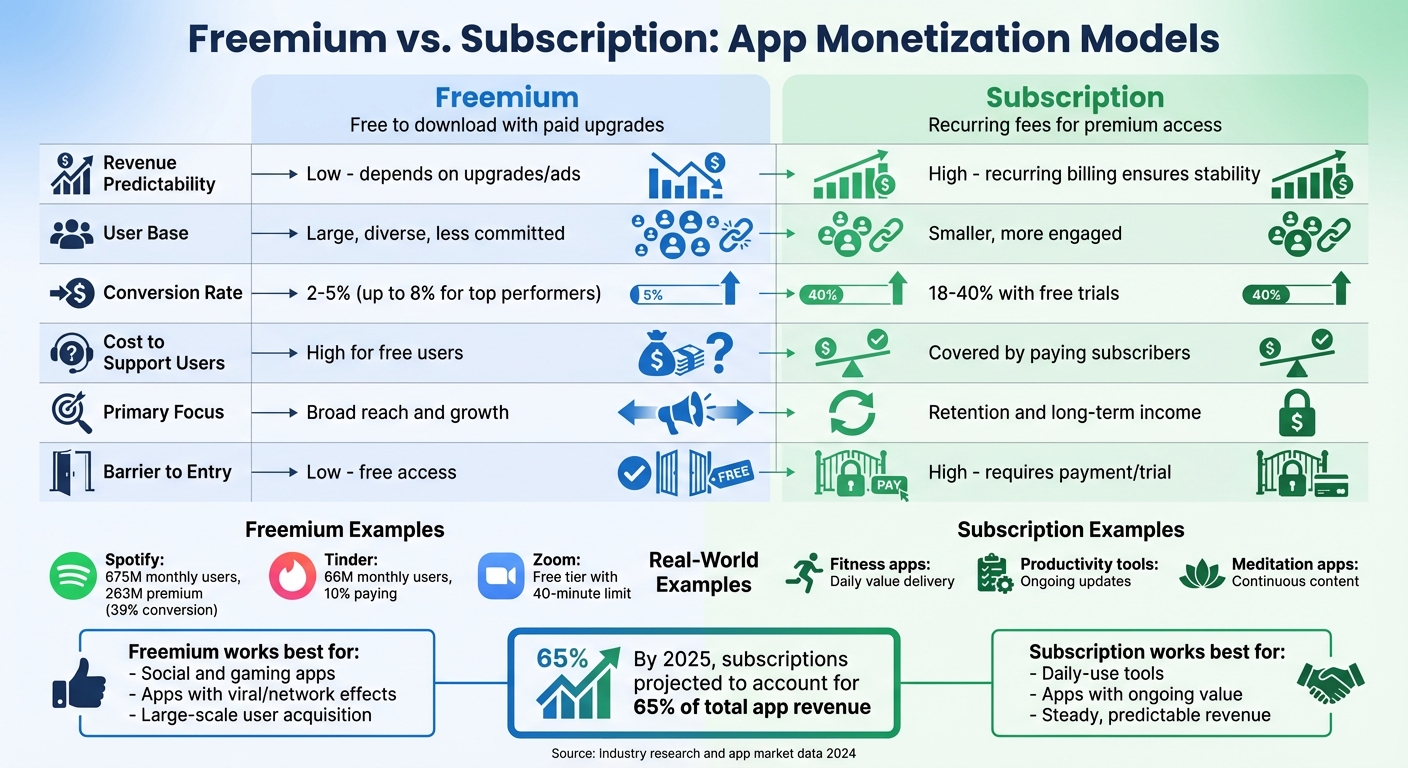
Freemium vs Subscription App Monetization Models Comparison
The freemium model gives users free access to basic features, while reserving premium tools and perks for those who pay. Instead of chasing immediate profit, the focus is on attracting a large audience by keeping the entry point free and accessible.
"Freemium should be treated as an acquisition model, not a revenue model. The free tier is the funnel that pulls in potential users, while the premium version is where monetization happens." – First Round Review
Revenue in this model comes from various sources like recurring subscriptions, usage-based pricing (e.g., extra storage), in-app ads, or one-time purchases for special add-ons. However, only about 2% to 5% of free users typically become paying customers, so success depends on scaling the user base significantly.
Take Spotify as an example. By Q4 2024, Spotify had 675 million monthly active users, with 263 million (around 39%) opting for a premium subscription. Free users are served ads, while premium subscribers enjoy an ad-free experience and offline listening. Similarly, Tinder offers free swiping but charges for extras like "Super Likes." About 10% of Tinder's 66 million monthly active users pay for premium features.
The strategy works because free users often upgrade when they hit usage limits, like Zoom's 40-minute cap on free calls. The challenge is finding the right mix of free features to keep users engaged while making premium benefits irresistible.
The table below highlights the key benefits and challenges of the freemium model.
| Benefit | Description | Challenge | Description |
|---|---|---|---|
| Lowered CAC | Reduces friction for new users by eliminating upfront payments. | Scalability Costs | Free users consume resources without directly contributing to revenue. |
| Viral Potential | Free tiers encourage word-of-mouth and referrals (e.g., Dropbox's referral system). | Conversion Dependency | Relies heavily on the small percentage (2–5%) of users who upgrade. |
| Data Collection | Captures user behavior data and monetizes non-paying users through ads. | Value Balancing | Over-restricting features can push users away, while being too generous may reduce upgrades. |
| Habit Building | Encourages long-term engagement, increasing user commitment over time. | Subscription Fatigue | Users may hesitate to commit to yet another paid service. |
The subscription model trades one-time payments for recurring fees - usually monthly or annual - giving users access to premium content. This setup provides a steady income stream, enabling developers to plan budgets, hire staff, and improve their products with more certainty.
Unlike the freemium approach, which prioritizes attracting a large pool of free users, subscriptions focus on keeping users engaged for the long haul. This is achieved by consistently offering value through regular updates, new features, and reliable service. Automated billing makes renewals hassle-free, ensuring a smoother experience for users and businesses alike. While freemium emphasizes user acquisition, subscriptions center on retention.
"For the companies with the skills to scale a subscription model, there is a lot to love about recurring revenue. You only have to acquire the customer once and you can set up predictable cash flows for a substantial amount of time." – Dan Layfield, Founder of Subscription Index
On average, about 1.7% of app downloads convert into paying subscribers within the first 30 days. While this might seem like a small figure, the top 5% of new apps generate over 200 times more revenue than the bottom quartile within 12 months of launch. In North America, the average Lifetime Value (LTV) per download is $0.35 - four times higher than the global average of $0.08. Subscription pricing often falls around $4.99 per week, $9.99 per month, or $29.99 annually, with annual plans typically offering a 17% discount compared to monthly payments.
The key challenge? Showing value immediately. Apps must create an "aha moment" within 60 seconds of installation. Without that instant connection, users are unlikely to commit to recurring payments. For apps that aren’t used daily, trial periods can range from 7 to 60 days to encourage habit-building.
Here’s a quick look at the strengths and challenges of the subscription model:
| Advantage | Description | Disadvantage | Description |
|---|---|---|---|
| Predictable Revenue | Regular fees provide financial stability and planning ease. | Churn Risk | Requires ongoing efforts to prevent users from canceling their subscriptions. |
| Higher LTV | Recurring payments increase the overall value per user. | Entry Barriers | High acquisition costs and user sensitivity to pricing can be obstacles. |
| Scalability | Digital platforms make it easier to grow with minimal costs. | Continuous Value | Demands frequent updates and improvements to justify ongoing payments. |
| Deep Insights | Usage data helps tailor product enhancements. | Subscription Fatigue | Users may cancel non-essential apps due to an overload of monthly expenses. |
Freemium and subscription models take vastly different approaches to revenue generation and user engagement. Freemium focuses on attracting large user bases by offering free features, converting a smaller percentage (typically 2%–5%) into paying customers. Subscriptions, on the other hand, rely on free trials to convert users into paying subscribers, with success rates ranging from 18% to 40%. These strategies shape not only how revenue is generated but also how user retention is managed.
Subscription models shine when it comes to financial predictability. With recurring billing cycles, they deliver steady and reliable income. Freemium models, however, depend heavily on variable in-app purchases and conversion rates, making revenue less predictable. Additionally, freemium apps bear the cost of supporting free users who may never contribute directly to revenue. As Alex Rampell, CEO of TrialPay, aptly notes:
"One price means you're leaving a lot of money on the table."
Retention strategies also differ significantly. Freemium apps aim to create "aha moments" - those instances when users realize the value of the app - within the free tier to encourage gradual upgrades. Subscription apps, in contrast, must consistently deliver ongoing value through updates and improvements to keep users engaged and reduce churn.
Real-world examples highlight these contrasts. Spotify’s impressive 39% conversion rate underscores the subscription model’s ability to drive revenue. Meanwhile, Tinder’s 10% conversion rate reflects freemium's strength in achieving broad reach and brand visibility. These models serve distinct goals: freemium emphasizes user acquisition and awareness, while subscriptions focus on sustained revenue and long-term customer value.
Here’s a quick comparison of key factors:
| Factor | Freemium Model | Subscription Model |
|---|---|---|
| Predictable Revenue | Low; relies on variable conversions and upsells | High; supported by recurring billing cycles |
| Primary Focus | Broad user acquisition and growth | Long-term engagement and retention |
| Barrier to Entry | Low; free access lowers commitment | High; requires upfront payment or trial |
| Customer Base | Large, diverse, often sporadic users | Smaller, highly invested audience |
| Infrastructure Costs | High; free users consume resources | Covered largely by paying subscribers |
| Monetization Strategy | In-app purchases, ads, premium upgrades | Tiered plans or flat, recurring fees |
| Typical Conversion Rate | 2%–5% (up to 8% for top performers) | 18%–40% for free trials |
The choice between freemium and subscription models largely depends on how quickly users experience the app's value. For apps that deliver their "aha moment" almost immediately - like photo editors or fitness trackers - freemium or free trial models are a good fit. On the other hand, apps where value builds over time, such as fintech or health tracking tools, often work better with subscription plans that include a free tier to hook users gradually.
How often users engage with your app is another key factor. Apps designed for daily use - like meditation apps, productivity tools, or fitness coaching platforms - are well-suited to subscriptions because users expect continuous value. Meanwhile, apps that serve a more occasional purpose, such as QR scanners or niche utilities, tend to perform better with one-time purchases or in-app purchases. Aligning your pricing model with user engagement habits ensures a smoother fit with their expectations and complements the timeline for delivering value.
Your operating costs also play a big role in deciding whether freemium is viable. As Stripe explains:
"Freemium hinges on giving away the exact right amount: enough to show value, but not so much that users never need to upgrade."
If supporting free users is expensive, freemium can become unsustainable. Subscriptions, with their recurring revenue, provide a more reliable way to cover these costs, especially for resource-intensive apps.
Market size and revenue goals are equally important. Freemium models rely on scale - you need a large user base because conversion rates typically hover between 2% and 5%. If your focus is on rapid user growth and brand awareness, freemium could be the way to go. However, if your priority is steady income and maximizing customer lifetime value, subscriptions are often the better choice. For instance, in 2021, the top 100 subscription apps generated $18.5 billion in revenue - a 41% increase from the previous year. This underscores the scalability and financial stability of subscription-based models.
Lastly, think about your product's feature set. Freemium works well if there's a clear distinction between basic and premium features. However, if the app's value lies entirely in its premium offerings, a trial-to-subscription model may be more effective. The goal is to make the free tier functional enough to showcase the app's value while leaving advanced users motivated to upgrade.
Choosing the right monetization strategy for your app isn't just about the mechanics - it’s also about understanding your market and how your users behave.
Freemium models thrive when viral network effects come into play. Apps like Zoom and Skype are great examples. Their value grows as more people use them, making a free tier essential for driving adoption. Take Zoom’s 40-minute meeting limit - it’s a perfect nudge that encourages users to upgrade. This approach isn’t just about offering something for free; it’s about leveraging that free tier to fuel viral growth and cut customer acquisition costs. This strategy works especially well in categories where network effects, rather than sheer volume, drive success.
Gaming and social apps lean heavily on freemium for scale. Free downloads paired with in-app purchases are a winning combination for these apps, often outperforming paid downloads in revenue generation. Tinder’s freemium model, for example, has helped it achieve massive adoption, even with a relatively modest conversion rate. This strategy appeals to price-sensitive users who may not pay upfront but are willing to subscribe once they’re hooked on the experience.
Subscription models shine when users expect ongoing value. Apps in fitness, meditation, and productivity categories are perfect candidates because their users rely on consistent updates, fresh content, or cloud services. Spotify is a standout example, with 263 million paid subscribers out of 675 million monthly active users by Q4 2024. These apps integrate seamlessly into users’ daily lives, making recurring fees feel justified. While many daily-use apps benefit from subscriptions, some may find a hybrid model more suitable.
Productivity apps can go either way, depending on their features. For apps with a clear divide between basic and premium functionalities - like unlimited storage or advanced automation - a freemium model works well. On the other hand, if most of the app’s value is tied to premium features, a trial-to-subscription approach is more effective. Consider Shmoody, a mental health app that uses a hybrid model. It even managed to recover about 20% of failed payments in just one week by implementing a subscription renewal recovery flow.
Your app’s vertical matters. Productivity apps often generate the most revenue by charging for downloads, in-app features, or subscriptions. Meanwhile, mass-market B2C categories like edtech, health and fitness, and dating rely on freemium to attract large user bases. Even with conversion rates as low as 2% to 5%, the sheer scale of millions of users can make this model highly profitable. Matching your monetization strategy to your app’s vertical is key to balancing growth with sustainable revenue.
Choosing the right monetization model for your app boils down to understanding your app's purpose, the habits of your users, and the value you provide. Subscriptions are ideal for apps that deliver ongoing value - think fitness apps, productivity tools, or platforms offering regular updates. On the other hand, freemium models excel in driving viral growth and leveraging network effects, making them a go-to for gaming, social apps, or tools that thrive on scale rather than immediate revenue.
By 2025, subscriptions are projected to account for 65% of total app revenue, showcasing their strength in delivering steady, predictable income. Meanwhile, freemium models continue to attract massive user bases, with conversion rates ranging from 2% to 5%. When scaled to millions of users, even these modest conversion rates can generate impressive revenue. The trick lies in aligning your monetization model with your app's category and understanding what your users are willing to pay for.
"Monetization strategy is critically important. It's not just a question of revenue; it's a question that influences your entire business model, including market positioning, user acquisition, UX and long-term sustainability."
– 8base
Experimentation is key. Use A/B testing to fine-tune pricing tiers, trial periods, and when to introduce paywalls. Keep a close eye on metrics like conversion rates, customer lifetime value, and churn to continuously improve. Many top-performing apps now adopt hybrid models - blending subscriptions with in-app purchases or ads - to appeal to diverse user segments and maximize earnings.
If you’re launching or optimizing your app, taking a tailored approach is essential. Dots Mobile offers comprehensive mobile app development services, including monetization strategy design, payment gateway integration, and A/B testing frameworks. Their expertise in mobile development, UI/UX design, and App Store optimization ensures you can craft a user-friendly monetization strategy that supports lasting growth. Use these insights to shape your approach and set your app on a path to success.
Choosing between freemium and subscription models comes down to your app's goals, target users, and the kind of content you offer.
Freemium is a great choice if your priority is to attract a large audience. By offering free access to basic features, you can draw users in and later encourage them to upgrade to premium features. This approach works well for apps that can hook users with a free experience before introducing paid options.
On the flip side, subscription models are ideal for apps that deliver ongoing value, like streaming platforms or productivity tools. With subscriptions, you benefit from steady, recurring revenue. However, success hinges on keeping users engaged and ensuring they see consistent value over time.
When deciding, think about your revenue goals, how complex it might be to manage in-app purchases or billing, and whether your app can maintain its appeal long-term. Freemium is all about growing your user base, while subscriptions focus on cultivating a loyal group of paying customers.
If you're looking to turn free users into paying customers, the key lies in emphasizing the value of your premium features. Show users how these features can solve their problems, save them time, or improve their overall experience with the app. It's not just about listing benefits - it’s about connecting those benefits to what your users care about most.
Use targeted messaging to make your pitch more compelling. For instance, personalized offers or time-sensitive discounts can create a sense of urgency and speak directly to individual user needs. The more tailored your approach, the more likely users are to consider upgrading.
A smooth upgrade process is also critical. Ensure the app is designed to make upgrading easy and frustration-free. Pay attention to user behavior to find the perfect moments to suggest an upgrade - like when someone encounters a limitation in the free version. These moments are when users are most likely to see the value of going premium.
Finally, trust is everything. Offer responsive customer support and clear, upfront pricing to help users feel confident about their decision. When users know they can rely on your app and your team, they're far more likely to make the leap to premium.
Running a subscription-based app isn't without its hurdles. One of the biggest challenges is tackling churn - the rate at which users cancel their subscriptions. Many subscribers drop off within the first few months, making it crucial to consistently provide value. Regular updates, exciting new features, and engaging content are key to keeping users invested. Without these, it’s hard to convince people that the recurring cost is worth it.
Another tricky aspect is figuring out the right pricing strategy. How do you make your app affordable enough to attract users while ensuring it remains profitable? This becomes even more complicated when you're catering to different audience segments. Add to that the logistical headaches of handling payment failures, cancellations, and renewals across various platforms, and it’s clear that managing a subscription model is no small feat. Success in this space hinges on retaining users, offering flexible pricing, and delivering consistent value.


