
July 6, 2026
⯀
15
min


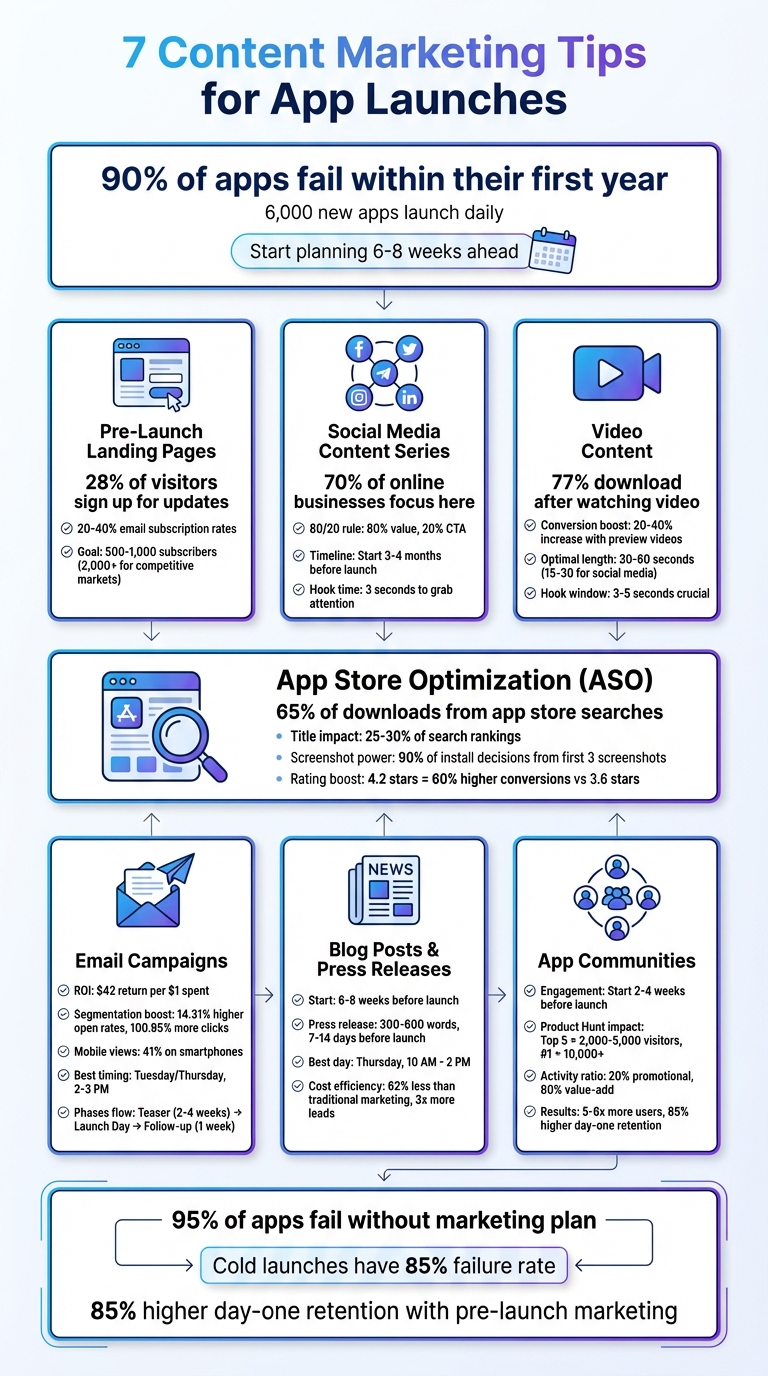
Launching an app without a marketing plan is risky - 90% of apps fail within their first year. Content marketing can help you stand out in a crowded market of 6,000 new apps launching daily. By focusing on strategies like pre-launch landing pages, social media campaigns, and optimized app store listings, you can build awareness, drive downloads, and improve user retention.
Here’s a quick breakdown of the 7 tips covered:
Each tactic works together to build momentum before launch and sustain growth afterward. Start planning 6–8 weeks ahead to maximize results and ensure your app gains the attention it deserves.
7 Content Marketing Strategies for Successful App Launches
Think of a pre-launch landing page as your app's digital storefront - a place to spark interest and gather emails from potential users before you even go live. Here's why it matters: 28% of visitors to a dedicated pre-launch page typically sign up for updates, and startups using this strategy often see email subscription rates between 20% and 40%.
The mobile app UI/UX design of your page should be straightforward and laser-focused on one main goal: collecting emails. Start with a compelling headline that clearly communicates your app's value, add high-quality visuals like mockups or a teaser video, and make sure there's an eye-catching sign-up form. Including a few bullet points about key features can boost conversions by 11%, while testimonials from beta testers can increase sign-ups by as much as 34%. And since 52% of global traffic now comes from mobile devices, ensure your page is mobile-friendly.
To supercharge your efforts, consider adding a referral program. For example, in 2024, Tim Hanson, CMO and Cofounder of Penfriend, ran a 10-week pre-launch campaign with a waitlist offering exclusive day-one discounts. The result? $40,000 in revenue on launch day, all thanks to the email list. As Hanson put it:
"The waitlist was the only place you could get the day one discounts. That runway turned into a $40k day one purely from people on that list".
Keep your audience engaged by sending regular updates. Share behind-the-scenes looks at your app’s development or sneak previews of upcoming features. Tools like Unicorn Platform or WordPress plugins like SeedProd can help you build these pages without needing to code. For smaller apps, aim to gather 500 to 1,000 subscribers, but if you're entering a competitive market, you might need 2,000 or more.
Your email list will become the backbone of your outreach efforts as you move into the next phases of your launch.
Social media is where your app’s personality shines - and it’s also where over 70% of online businesses focus their promotional efforts. To make an impact, avoid random posts. Instead, craft a consistent, strategic content series. This approach not only reinforces your app’s story but also builds excitement leading up to launch.
Start by defining 2–3 core themes that reflect your app’s identity and resonate with your audience. For example, you might focus on "Feature Spotlights", "Behind-the-Scenes Development", or "User Success Stories." Once you have your themes, turn them into recurring formats - like a weekly "Feature Friday" post your followers can look forward to.
Stick to the 80/20 rule: spend 80% of your posts delivering value (educating, entertaining, or inspiring) and 20% on calls to action. Marketing strategist Simon Lee from Glance sums it up perfectly:
"Content marketing isn't about shouting the loudest - it's about saying something worth listening to".
Short, engaging videos (15–30 seconds) are great for showing how your app solves real-life problems. You could also create "day in the life" content to highlight relatable use cases [24, 27].
Adapt your content to fit each platform’s strengths. Instagram works best with eye-catching visuals and Reels, TikTok rewards vertical, creative videos, LinkedIn is ideal for professional insights or case studies, and X (formerly Twitter) excels with quick updates and interactive polls. Remember, you’ve got about three seconds to grab attention.
Start your social media campaign 3–4 months before launch. Use this time to build momentum and attract beta testers. Share authentic moments - debugging hurdles, team celebrations, or hitting major milestones. These behind-the-scenes glimpses help create a genuine connection with your audience. When combined with thoughtful planning, this authenticity can transform your social media into a powerful launchpad.
Video content is a powerful tool for app launches. Did you know that 77% of people have downloaded an app after watching a video about it? Adding a preview video to your app store listing can increase conversion rates by 20% to 40% compared to just using screenshots. Well-crafted videos not only generate excitement but also help establish trust in your app.
Focus on demonstrating how your app can make life easier or solve problems, rather than simply listing features. A good structure for your video might look like this: Problem → Action → Result → Benefit. For example, instead of saying, "Our app has a calendar feature", show a relatable scenario - a user missing appointments - and how your app helps them stay organized effortlessly.
Keep your videos short and engaging. Research shows that 30–60 seconds is the sweet spot for most platforms, while 15–30 seconds works best on social media. The first 3–5 seconds are crucial, so grab attention with a strong hook - this could be a bold visual, a question that sparks curiosity, or a glimpse of the app's end benefit.
Make sure your videos are accessible. Add captions or text overlays since many users watch videos with the sound off. If you're recording your app's screen, slow down your taps and swipes so viewers can easily follow along. Also, close other apps and turn off notifications to keep the focus on your app.
Finally, tailor your videos for each platform. For example, iOS app previews must be 30 seconds long and device-specific, while Google Play allows longer, YouTube-style videos. TikTok thrives on raw, authentic content, whereas Instagram favors polished visuals. No matter the platform, always end with a clear call to action like "Download Now" or "Try It Free".
Once you've created engaging videos, it's time to channel that interest into downloads with a standout app store listing. This is where most downloads come from - over 65% of app downloads are driven by app store searches. If your listing doesn’t grab attention immediately, users will scroll right past it.
Start by focusing on your app title and subtitle, as these are key to your app's visibility. The title alone contributes to about 25% to 30% of your search rankings. To maximize impact, place your most important keyword at the beginning and use every character available: 30 for iOS titles and 50 for Android. For iOS apps, take advantage of the hidden 100-character keyword field by filling it with unique terms not already in your title or subtitle, separated by commas without spaces.
Screenshots play a major role in driving installs. The first three screenshots influence 90% of a user's decision to install, and half of all installs come from what’s visible without scrolling. Make your first screenshot count by showcasing a key feature - avoid starting with a login screen or a generic interface. Use brief captions (3–7 words) that emphasize benefits rather than features, and ensure the text is legible even at thumbnail size. Repurposing visuals from your video content can further enhance your listing. Plus, Apple now uses Optical Character Recognition (OCR) to index text in screenshots, so captions can also improve search rankings.
Ratings and reviews matter - big time. Jumping from 3.6 to 4.2 stars can increase conversion rates by up to 60%, and a 4.0+ star rating is often the minimum for apps to be featured. Actively manage your reviews by responding to negative feedback within 24–48 hours to show users you care. Encourage reviews after users complete a positive action in your app, like finishing a task, rather than immediately upon launch.
To refine your app store presence, use A/B testing tools like Google Play Store Listing Experiments or Apple's Product Page Optimization. Experiment with elements like icon colors, screenshot order, or caption text to see what resonates best. Keep in mind that leading apps update their listings 1–4 times per month. Frequent updates signal that your app is actively maintained, which can improve rankings. If you need professional assistance with App Store optimization, Dots Mobile offers ASO services as part of their comprehensive mobile app development packages.
Email marketing delivers an impressive $42 return for every dollar spent, making it a powerful tool to boost app downloads. The key? Start building your email list early. As Glance wisely states:
"The best time to start building your email list is yesterday. The second best time is right now, before you write a single line of code."
To maximize results, structure your email campaign in three phases:
This phased approach allows you to build momentum and tailor your messaging for different stages of your audience's journey.
Segmentation can dramatically improve your campaign's effectiveness. In fact, segmented emails see 14.31% higher open rates and 100.95% more clicks compared to generic email blasts. To segment effectively, consider factors like:
Most email platforms now offer automated tools to simplify segmentation based on user behavior.
With 41% of email views happening on smartphones, mobile optimization is non-negotiable. Design your emails with a single-column layout, include large buttons that are easy to tap, and use concise subject lines (under 50 characters) with action-oriented language. Timing also plays a role - sending emails on Tuesdays or Thursdays between 2:00 PM and 3:00 PM often yields the best engagement rates.
After users download your app, an onboarding email can make all the difference. Send it within 48–72 hours to guide users through key features and reduce the risk of app abandonment (only 3% of users stick with apps after 30 days). Enhance the experience by including screenshots or GIFs that demonstrate core functionalities. Use deep links to direct users to specific app features instead of the home screen for a smoother experience.
Press releases and blog posts work hand-in-hand to strengthen your app launch strategy. While press releases help you control the narrative, blog posts provide actionable insights that engage your audience. Together, they boost your app's visibility and establish credibility for your brand. Considering that around 35% of mobile app failures stem from poor marketing efforts, these tools are essential for success.
When crafting a press release, address the 5 Ws: who, what, when, where, and why. Stick to a concise 300–600 word count, write in third person using AP style, and structure it like an inverted pyramid - place the most critical information at the top, followed by supporting details. Timing is everything: distribute your press release 7–14 days before launch and publish it 1–2 days prior to your app's release. Research shows that Thursdays, particularly between 10:00 AM and 2:00 PM, tend to yield the highest open rates among journalists.
Blog posts, on the other hand, allow you to connect with your audience on a more personal level by addressing their needs. Start publishing blog content 6–8 weeks before your launch to build SEO traction and attract early sign-ups. Focus on creating content that solves real problems your users face, and optimize it with relevant keywords in titles and headers. Blog posts are also a great place to include direct App Store and Google Play links, making it easier for users to download your app.
To make your outreach efforts even more effective, prepare a media kit. Include high-resolution screenshots, a 30-second demo video, your logo, and a fact sheet. This makes it easier for journalists to cover your app. Keep in mind that 47.5% of journalists receive over 100 business-related emails every day, so personalized pitches tailored to their specific interests are far more effective than generic mass emails.
Timing is critical. Avoid sending press releases on Fridays, weekends, or major holidays when newsrooms are typically understaffed. If you don’t hear back after your initial outreach, follow up with a personalized pitch within 3–7 days. With nearly 100,000 new apps hitting Google Play and over 34,000 launching on the App Store each month, standing out requires precision and quality.
After laying the groundwork pre-launch, diving into app communities can significantly extend your reach. These online spaces are home to your first superfans - people who can provide honest feedback, advocate for your app, and help create the social proof needed to succeed in app stores.
To make the most of these communities, start engaging 2–4 weeks before your launch. Focus on adding value by answering questions, sharing knowledge, and contributing to discussions before mentioning your app. For platforms like Reddit, keep in mind that many high-quality subreddits require a minimum of 500–1,000 karma to post. Build trust by maintaining a balance - limit promotional posts to about 20% of your activity.
Different platforms can play unique roles in your strategy:
When introducing your app, frame it as a request for feedback. For example, instead of saying, "Check out my app", try something like, "I struggled with [problem] too. Here’s what I tried, and why I eventually built [app] to solve it." This approach feels more authentic and encourages meaningful conversation. On launch day, respond to comments quickly - ideally within 15–30 minutes. This level of interaction boosts your post's visibility on platform algorithms.
A well-coordinated, multi-channel launch that leverages community engagement can deliver impressive results. You could see 5–6x more users and an 85% increase in day-one retention rates. Beyond downloads, these communities provide a foundation for long-term growth through genuine advocacy and word-of-mouth.
Even the best marketing plan will fall flat if your app doesn’t convert users. That’s where Dots Mobile steps in. They specialize in mobile app development that ensures every marketing dollar you spend delivers results. Covering everything from concept validation to App Store launch, their 360° approach includes UI/UX design, iOS and Android development, backend development, quality assurance, and App Store Optimization (ASO). The result? A smooth and impactful app launch.
Their process starts with market validation - a critical step to avoid expensive missteps later. Through market research and prototyping, they confirm your app concept and pinpoint the needs of your target audience. This ensures your app is built to solve real problems and that your marketing aligns with user expectations. If you’re a non-technical founder, they also offer MVP prototyping services, turning your ideas into functional products without requiring you to know coding languages like Swift or Kotlin.
Unlike many developers, Dots Mobile integrates App Store Optimization into the development process from the very beginning. By incorporating keyword strategies and optimizing storefront elements early, your app is set up to perform well the moment it’s launched. This is key because app store searches drive most discoveries - 63% of iOS users and 58% of Android users find new apps this way. A polished, optimized listing on day one ensures your marketing efforts deliver maximum impact.
To handle growth, Dots Mobile builds apps with scalable infrastructure. Using modern APIs, caching, and distributed architectures, they ensure your app can support millions of users without slowing down. This is especially important when your marketing campaigns succeed - there’s nothing worse than attracting users only to lose them to crashes or sluggish performance.
With over two decades of experience, Dots Mobile has a proven track record in the competitive app market, where global app downloads are predicted to hit nearly 150 billion annually by 2026. They’ve developed AI-powered apps for industries like fitness, beauty, and lifestyle, showcasing their ability to create scalable, user-friendly solutions across a range of sectors.
Launching an app without a well-thought-out marketing plan is a recipe for failure. The harsh reality? 95% of apps fail within their first year, and cold launches without a pre-built audience have an 85% failure rate. The strategies outlined here turn your app launch into more than just a one-day event - they help create a sustained movement. From pre-launch landing pages that capture email leads to social media buzz and blog content that builds authority, these tactics work together to amplify your app's visibility. When executed simultaneously, they can boost your app's performance in app store algorithms and help you stand out in a market packed with over 5 million apps.
Start your efforts 6–8 weeks before launch. Apps that invest in pre-launch marketing often see up to 85% higher day-one retention rates compared to those that skip this step. Focus on consistent messaging, nurturing your waitlist, and encouraging sharing through referral programs. Content marketing, in particular, is a cost-effective way to generate leads - it costs 62% less than traditional outbound marketing yet delivers three times as many leads. By planning early, you’re setting the stage for sustainable growth.
Content marketing doesn’t just help with the launch - it’s a long-term approach to building trust and turning leads into loyal users. With 70% of people preferring to learn about companies through articles rather than ads, your content becomes the essential link between your app and the users who need it most. By applying these seven content marketing strategies, you’re not only boosting your initial launch but also establishing a brand that users can trust.
"Launching an app without a strategy is like throwing a party without invitations; no one shows up." - Venkatesh C.R, CEO, Dot Com Infoway
Pair these marketing techniques with expert development support to ensure your app is technically sound and optimized from day one. If you’re ready to launch an app that captures users' attention and thrives in a competitive market, consider working with experienced teams like Dots Mobile. With consistent effort and the right strategies in place, your app can gain the momentum it needs to succeed.
Building a waitlist of several hundred to a few thousand users is often recommended to create buzz and confirm interest in your app. Many experts advise targeting at least 500 to 1,000 early signups. This approach ensures you’ll have an engaged audience eager to dive into your app as soon as it launches.
If your app isn't ready for a full reveal, you can still create buzz and build trust by focusing on strategic content. Share the concept behind your app, offer behind-the-scenes updates, or highlight the problem your app aims to solve.
You can also engage potential users with early beta testing opportunities, progress updates, and content that emphasizes the app's benefits. These approaches help generate excitement and anticipation while keeping the app itself under wraps until it's fully prepared for launch.
When it comes to App Store Optimization (ASO), some updates can lead to faster results than others. Two key areas to focus on are the first two screenshots and the app icon. These elements play a big role in influencing user decisions and are also scanned by Apple's OCR technology, which helps improve your app's visibility in search results. By refining these aspects, you can see a boost in user acquisition, particularly during the critical app launch period.


