

February 12, 2026
⯀
12
min


Fitness apps are booming, but scaling their backend systems is a massive challenge. With millions of users and real-time data demands, platforms must process biometric data, handle traffic spikes, and ensure near-perfect reliability. Here's how leading apps like FITTR tackled these obstacles:
This article explores the strategies and technologies that power scalable backends, ensuring fitness apps meet user expectations while staying cost-efficient.
To ensure a fitness app can handle growing demands, platforms need to establish clear performance objectives that align with user expectations and business growth. These goals aren’t just about uptime - they must address the unique needs of real-time biometric tracking, fluctuating traffic, and instant responsiveness. These priorities set the stage for the technical challenges outlined below.
Fitness apps juggle a constant stream of data from devices like GPS trackers, heart rate monitors, and motion sensors - often processing thousands of signals per second. The challenge? Users expect near-instant updates during workouts. To meet these expectations, the backend must maintain latency under 150 milliseconds, ensuring users receive timely feedback to adjust their performance mid-session.
But it’s not just about speed. Backends also need to optimize sensor sampling rates and handle delayed data. For example, Apple HealthKit data might sync hours - or even days - after a workout, requiring the system to recalculate summaries automatically. Additionally, data from various devices needs to be normalized to provide users with unified and accurate analytics.
Reliability is non-negotiable for fitness platforms. A 99.99% availability rate is essential to keep users engaged and prevent frustration during workouts. For instance, in early 2024, FITTR revamped its infrastructure on AWS to support the launch of its HART smart ring. By transitioning from a monolithic system to a microservices architecture with Amazon ECS and Amazon MSK, FITTR achieved 99.99% uptime while cutting backend costs by 50%.
Microservices also play a key role in isolating faults. If one component - like a social feed - fails, it won’t bring down the entire system. Additionally, multi-region deployments across different availability zones ensure that even if one data center experiences an outage, users in other regions can continue their workouts without interruption.
Once real-time processing and reliability goals are addressed, the next challenge is scaling to handle fluctuating user loads. Platforms like Under Armour's Connected Fitness, which serves more than 180 million users, experience predictable spikes during events like New Year’s Day or weekends. Similarly, FITTR’s revamped backend manages surges up to 1,000× the average load by leveraging dynamic container orchestration and auto-scaling.
Event-driven architectures, using tools like Apache Kafka or Amazon SQS, help manage sudden bursts of data from wearables and social features. Whether 10,000 or 10 million users log workouts simultaneously, these systems ensure consistent performance and responsiveness.
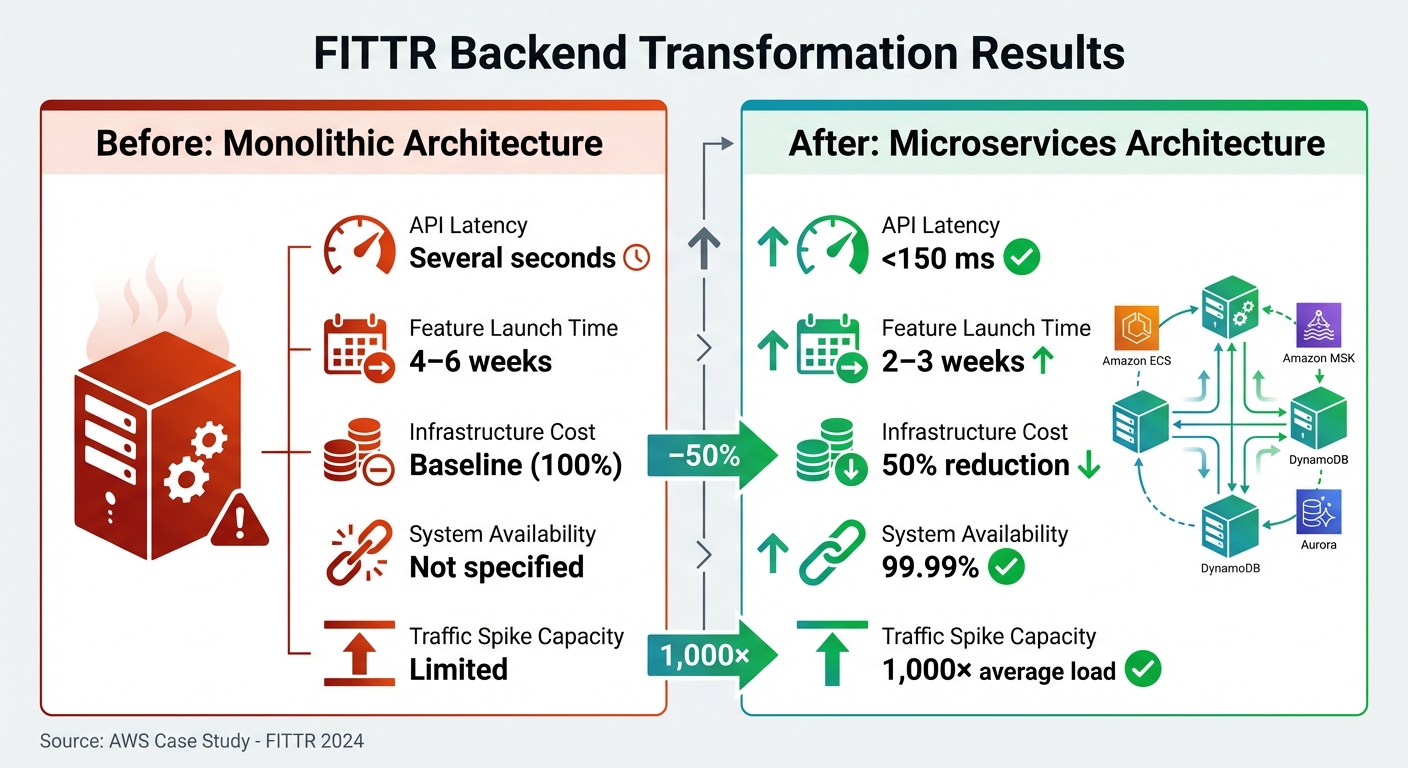
FITTR Backend Migration Results: Monolithic vs Microservices Performance Metrics
FITTR faced some major hurdles as it grew, prompting a complete overhaul of its backend systems to achieve real-time responsiveness and cut costs. The platform, an India-based fitness app, ran into trouble with its traditional monolithic architecture in 2022. Because all components were tightly connected, scaling individual features wasn’t possible. When wearable data usage spiked, the entire application had to scale, which sent infrastructure costs soaring.
Between 2022 and 2024, FITTR’s Head of Engineering, Mandar Nilange, spearheaded the move from a monolithic PHP backend to a microservices architecture. They used Amazon ECS for containerization, breaking the platform into independent services like data ingestion, user management, social features, and coaching. This shift allowed teams to roll out features independently, speeding up development cycles. This transition is essential for companies looking to launch high-quality mobile apps that can scale effectively.
"With AWS, we've built a flexible, scalable foundation that not only accelerates our time-to-market but also positions us as leaders in shaping the future of fitness technology."
FITTR used the Strangler Fig Pattern for the transition, starting with the data synchronization service, which processes streams from wearables. By isolating this high-volume component, they ensured the user interface wouldn’t be affected by issues in peripheral services. This approach improved fault isolation, so features like workout tracking stayed reliable even if other services experienced problems.
FITTR adopted a polyglot persistence strategy to handle different types of data efficiently. Amazon Aurora was used for structured relational data, such as user profiles and subscriptions, while DynamoDB managed the high-volume health metrics from wearables. For real-time data processing, they turned to Amazon MSK (managed Kafka), which kept latency under 150 milliseconds. Redis was added as an in-memory cache to handle high-throughput read operations like live class schedules and workout summaries, easing the load on primary databases.
Amazon ECS played a key role in managing traffic surges, especially during marketing campaigns when traffic could spike up to 1,000 times the usual volume. The system automatically scaled containers up or down, optimizing resource use and cutting infrastructure costs by 50%.
The results of FITTR’s backend transformation were striking. System availability jumped to 99.99%, and API latency dropped from several seconds to under 150 milliseconds, enabling real-time feedback for users during workouts. The migration also reduced deployment risks, as teams could now roll out updates to individual services without risking the stability of the entire platform.
| Metric | Pre-Revamp (Monolith) | Post-Revamp (Microservices) |
|---|---|---|
| API Latency | Several seconds | <150 ms |
| Feature Launch Time | 4–6 weeks | 2–3 weeks |
| Infrastructure Cost | Baseline | 50% reduction |
| System Availability | Not specified | 99.99% |
| Traffic Spike Capacity | Limited | 1,000× average load |
These upgrades directly improved the user experience. Faster API responses meant workout data synced instantly, coaching recommendations were delivered without delays, and live class features stayed stable even during heavy traffic. The new architecture also opened doors to advanced features like AI-driven coaching and predictive analytics.
A thorough code audit can uncover bottlenecks and pave the way for significant performance improvements. For example, one team transitioned performance-critical services from Node.js to Java, leveraging the Java Virtual Machine (JVM) to speed up JSON serialization and deserialization. This change proved invaluable during the COVID-19 shift to digital classes, where traffic surged tenfold at the end of live workout sessions. Engineers managed to reduce API Gateway instances to just 1/7th of the original requirement and cut homepage p90 latency from 410 ms to 90 ms. By eliminating circular dependencies, such as redundant calls between Payment and Training services, they also significantly reduced server load.
Database performance was another focus area. The team introduced read replicas for MongoDB and MySQL, scaled managed databases vertically using AWS RDS, and ensured tier-1 services had dedicated database servers to isolate potential failures. For leaderboard features, they replaced inefficient O(N) counting operations with an O(log N) approach, caching scores at specific rank intervals. This method, inspired by Strava, reduced leaderboard load times from over 40 seconds to under 250 ms.
These optimizations not only improved performance but also set the stage for seamless scaling and automated deployment strategies.
In May 2021, Strava Engineering showcased the power of feature switches and "dark launches" during a migration of their club leaderboard system. Led by Senior Software Engineer Mike Kasberg, the team incrementally rolled out writes to a new Redis-based system - starting with 10% of users and gradually expanding to all users. This approach resulted in a 4× improvement in P99 response times without any downtime.
"By enabling writes to the new system... we were able to load test writes on the new system in prod and populate it with data while users continued seeing data from the old system." – Mike Kasberg, Senior Software Engineer, Strava
Predictable traffic spikes call for pre-scaling pipelines rather than relying solely on reactive auto-scaling. Scheduled scaling events can prepare systems for peak hours, ensuring they handle sudden surges effortlessly. Between 2019 and 2021, a U.S. fitness platform serving 6.4 million members worked with Altoros to achieve zero downtime during a microservices migration. This success was powered by AWS Lambda, Amazon SQS, automated security checks, and test coverage using tools like Mocha and Jest.
With optimized code and robust CI/CD pipelines in place, adopting protocols for low-latency communication can further enhance real-time features.
Real-time features demand protocols that deliver data instantly while minimizing backend strain. WebSockets are a go-to solution for pushing live metrics - such as heart rate and GPS location - directly to user interfaces, sidestepping the delays of traditional polling methods. For wearable devices, Bluetooth Low Energy (BLE) protocols were fine-tuned by caching discovered services and using targeted scan filters.
At Fitdesk, engineers modernized their backend using a Node.js and NestJS architecture. They optimized BLE communication by mapping GATT services and employing targeted scan filters, reducing device pairing time by 35% and increasing BLE sync reliability to over 99%. By implementing a 1-second render tick to interpolate delayed data packets, they ensured smooth real-time visualizations even during connectivity issues.
For handling high-volume data streams, a managed Kafka solution delivers millisecond-range latencies, while Redis serves as an in-memory cache for live session metrics, bypassing the need to query primary databases. This combination of WebSockets, optimized BLE protocols, and efficient stream processing ensures a seamless real-time experience, vital for scaling fitness apps and keeping users engaged.
At Dots Mobile, these strategies form the backbone of our approach to creating scalable and high-performing backends for fitness applications, ensuring users enjoy a smooth and responsive experience.
The strategies and technological updates implemented led to measurable gains in both performance and user engagement. Here's a closer look at the outcomes.
FITTR's backend overhaul delivered impressive results, cutting server costs by 50% and improving availability to an impressive 99.99%. By transitioning to AWS microservices, the platform also shortened its feature launch timeline from six weeks to just two to three weeks, enabling quicker responses to user demands.
"By optimizing resource utilization, the platform's shift to Amazon ECS also helped reduce costs by 50 percent." – AWS Case Study: FITTR
Similarly, BowFlex (Nautilus, Inc.) experienced a 10–20× performance boost after Coherent Solutions rebuilt its order-processing and e-commerce backend using a serverless, cloud-native architecture on AWS. This upgrade eliminated order backlogs during peak demand, and the improved app stability led to higher user ratings on Google Play.
During the COVID-19 pandemic, cult.fit (formerly cure.fit) faced massive traffic spikes - up to 10× - at the end of live workout sessions. By optimizing its backend, the platform reduced API Gateway instances to 1/7th of the original count, while slashing homepage p90 latency from 410 ms to 90 ms and p50 latency from 280 ms to 50 ms.
The improvements in backend performance directly contributed to growth in user engagement and an expanded user base. For example, a leading Indian wellness platform partnered with Daffodil Software to modernize its mobile backend using PHP (Laravel) and PostgreSQL. This overhaul supported a surge in users, growing the platform from 1 million to over 6 million users.
Fitdesk reported a 30% increase in Weekly Active Users after implementing a Node.js and NestJS backend paired with a Flutter frontend. Within three months of launching the updated app, it achieved over 20,000 downloads, with BLE sync reliability exceeding 99%. Meanwhile, Zwift saw significant backend optimizations in its Single Sign-On service, achieving a 60% reduction in P95 latency and a 25% drop in CPU utilization, all without requiring code changes.
"With the new app, our users feel like they've got a personal coach in their pocket, one that knows them, adapts to them, and keeps them coming back. It's not just workouts anymore, it's a relationship." – Alexandr Maslyakov, Project Manager, Coherent Solutions
At Dots Mobile, scalable backend architecture has proven transformative for fitness apps. The ability to handle 1,000× traffic growth while maintaining sub-150 ms API latency isn't just a technical milestone - it’s a key factor in keeping users engaged and ensuring their loyalty.
To build a fitness app that thrives in a competitive market, your backend must be designed for real-time performance, cost efficiency, and future growth. Handling data like GPS, heart rate, and motion sensors with millisecond-level response times is crucial, especially during traffic surges that can spike up to 10× the usual load. These are the core principles behind the architectural changes outlined earlier.
Transitioning from a monolithic structure to microservices can dramatically enhance user engagement and operational efficiency. This shift ensures your app responds instantly to user actions, transforming it from something users might abandon into a reliable "training companion" they depend on.
Performance optimization should be a priority at every stage of development. As cult.fit Engineering highlights, fostering this mindset as part of your engineering culture is essential.
Experienced developers play a critical role in ensuring smooth transitions and avoiding downtime. Dots Mobile is a prime example of a team that excels in creating scalable fitness app backends. Using technologies like Python, Kotlin, and Java, they craft systems capable of handling real-time data processing, integrating AI-driven personalization, and supporting wearables. Their comprehensive approach, which includes backend development and App Store optimization, ensures your app scales effectively while maintaining top-notch performance.
The takeaway? Invest in your backend infrastructure from the start. Successful fitness platforms aren't just about offering great workouts - they're about reliably delivering those workouts to users, no matter the scale.
Switching from a monolithic structure to a microservices architecture can significantly boost the scalability and efficiency of fitness apps. With microservices, different parts of the app function independently, allowing each service to be developed, deployed, and scaled on its own. This approach ensures better use of resources and speeds up updates.
Microservices also enhance elastic scalability, enabling the app to manage sudden spikes in user activity without system overloads. By targeting specific functions, they simplify operations and help cut cloud expenses since resources are allocated only where they’re most needed.
Fitness apps can process real-time data quickly and with minimal delays by leveraging a few key technologies and strategies. For instance, WebSocket and MQTT protocols allow for continuous, low-latency communication, which is essential for instant updates. An event-driven architecture, particularly a publish/subscribe model, ensures data is handled and delivered promptly.
To cut down on repetitive network requests, in-memory caching can store frequently accessed data temporarily, speeding up access times. Meanwhile, edge computing processes data closer to the user, reducing the time it takes for information to travel back and forth. Finally, designing systems to adapt to varying network conditions ensures the app remains reliable and performs well, even in less-than-ideal environments.
Fitness apps ensure they stay reliable and perform smoothly during sudden spikes in traffic by using scalable backend systems. A common approach involves microservices, which let separate parts of the app function independently. This setup is paired with elastic autoscaling, a feature that automatically adjusts server capacity based on how much demand there is at any given moment.
Cloud infrastructure also plays a major role in keeping these systems running seamlessly, helping apps handle high user activity without disruptions. Together, these methods not only keep the app scalable but also deliver a seamless experience by reducing downtime and maintaining consistent performance, even during the busiest periods.


